

Anthony Magnabosco does “Street Epistemology,” which was a method of Socratic questioning and dialogue invented by Peter Bogossian in his controversial book A Manual for Creating Atheists (2013). In Street Epistemology, the street epistemologist has a Socratic-style conversation that targets how people came to hold their beliefs rather than targeting the beliefs themselves. This is a highly effective means of having a dialogue across divides and differences, even in deeply entrenched beliefs like religious and political adherence (for more depth on this method, see Peter’s more recent book with New Discourses founder James Lindsay, How to Have Impossible Conversations (2019)).
Recently, Anthony loaded a conversation (part 1, part 2) with someone named Vanessa who presented the belief equity, in the Critical Social Justice sense, and wanted to discuss it by using epistemic justice as a way to understand it. Their conversation then focused upon epistemic justice and much else that is relevant to the Critical Social Justice mindset, especially about knowledge and power. It’s a very compelling watch, as Anthony is very capable at revealing the weakness of this way of thinking, which ultimately derives from the postmodern philosophy of French Theorist Michel Foucault. Indeed, it’s one of the best examples of Foucauldian thinking in a young, contemporary activist that one could find.
Anthony Magnabosco isn’t the only street epistemologist out there who doesn’t just do street epistemology but also makes videos of his conversations and shares them on YouTube (check out Anthony’s channel here). Reid Nicewonder is another street epistemologist who does the same thing on the Cordial Curiosity channel.
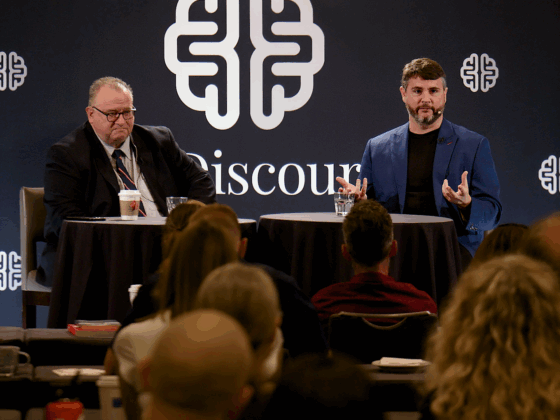
Reid recently invited James Lindsay to sit down and watch Anthony’s interview with Vanessa and to comment upon it in real time, elaborating in detail on how the Critical Social Justice mindset appears in Vanessa’s thinking and what it gets right and wrong. It’s a long but informative watch that can help you learn to understand the CSJ mindset not just as it appears in Theory and in articles, but also how it occurs in someone who really believes it.




6 comments
Really eye opening. Thanks for sharing this.
Second thought. Around 2:10:00, James points out that intersectionality has a mechanism for resolving conflicts around narratives, which Vanessa doesn’t seem aware of. I think that if Vanessa is aware of it, she’d still be hard-pressed to put it as plainly as James. If someone said “if a white person and a native person have a disagreement on the number of candies in a box, then we know the native person’s perspective is correct because native peoples are more oppressed than white people”, who would agree to that?
I wonder if Social Justice’s weak spot is that, if its foundational theories (intersectionality, Critical Theory, etc.) are talked about plainly, virtually everyone would reject it. Even its proponents, if they start thinking about it clearly, would reject it. Hence the word salad that surrounds SJ. It may be a rhetorical technique, but more fundamentally, it’s a psychological defense mechanism against the cognitive dissonance that comes from people’s needing to believe something they know to be false, in order to be considered morally good by their peers.
And also the “check your privilege”, “it’s not my job to educate you”, etc. responses to people who push back against social justice. If a person’s actions cause someone else to experience heightened cognitive dissonance, it’s pretty common for that second person to respond with anger and resentment. Especially when they are psychologically invested in not resolving the dissonance internally.
Seems to me the biggest weakness of Critical Social Justice theory comes with being able to identify injustice while denying that truth, reality, and unbiased epistemology exist.
From what I have read and heard, unfalsifiable gets mentioned regularly. If advocates can not conceive of data that would disprove their theory, then we need to start calling it what that implies; pseudoscience and/or religion.
Around 54:39, James wonders what critical theorists think will happen to things like air flight, supply chains for groceries, etc. in their ideal world. This reminded me of what Camille Paglia has talked about how second-wave and later feminism cultivates a lack of appreciation for how much of modern society’s infrastructure is a male project. That the continued operation of our society depends almost exclusively on men “building roads, pouring concrete, laying bricks, tarring roofs, hanging electric wires, excavating natural gas and sewage lines, cutting and clearing trees, and bulldozing the landscape for housing developments”.
https://www.aei.org/society-and-culture/camille-paglia-defends-men/
I’ve noticed, here and elsewhere, that when James talks about the people behind Critical Theory, that post-1989, all of them are women. I’ve been starting to come to the conclusion that modern American Critical Theory is basically a female project. As such, I suspect it would be very hard for it to have an understanding of, or appreciation for, what it takes to keep our society functioning.
I feel I should point out that most of the Katsina dolls or figures in museums were in fact made by Hopi and others from the South West for sale to tourists. This trade has been going on since the 1920s and still goes on today, with the most elaborate and attractive examples made for commercial reasons. While some represent ancestors, most represent immortal spirits which are public property, so it is hard to see how any of Vanessa’s arguments stand up. Should the Hopi themselves have been prevented from trying to make a buck? Might we dare to imagine that she has no idea what she is talking about?
This is a very interesting video. The idea of truth that keeps coming up here and in many discussion of Theory is an interesting one. I wonder if there is any connection to the idea of ‘the real’ vs. ‘the true’ in Charles Saunders Pierce’s work in the creating of Pragmatism? ‘The real’ is the thing out there that causes us to interact with and ‘the true’ is the what we create to explain ‘the real’.
You can get an introductory explanation starting at 29:46 of the lecture here.